Materials
How to choose watercolor paper: texture, weight and cotton
Paper changes how a watercolor looks as much as the paint does. (Privately, I think the paper matters a lot more than the paint.) Here is what the labels mean and what each choice does, with examples from Winslow Homer and John Singer Sargent.
Texture: hot press, cold press, rough
- Hot press is smooth. Paint sits on the surface and dries quickly, so it suits line work, fine detail and flat, even color. Hard edges and blooms show more on it.
- Cold press (sometimes labeled NOT) has a medium texture. It is the most common choice and handles both washes and detail.
- Rough has the strongest texture. A dry brush skips over the bumps and leaves flecks of white paper, which works well for light on water, leaves and stone.
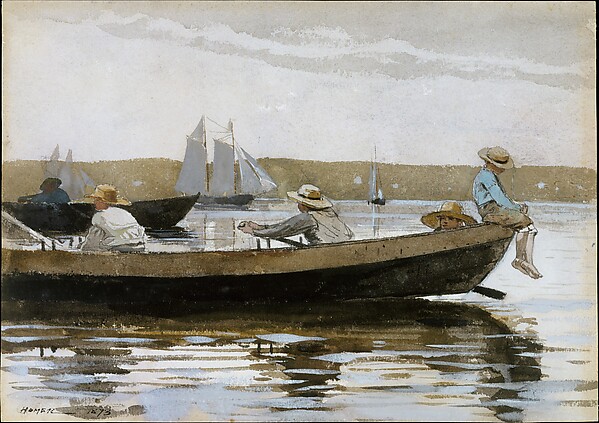
The Met lists the paper as medium rough textured white wove. Look at the water and the sky: the washes break up slightly over the grain, which keeps large flat areas from looking dead.
Weight
Weight is listed in grams per square meter (gsm) or in pounds (lb). The common ones are:
- 190 gsm (90 lb). Light. Buckles when it gets wet. Fine for small sketches.
- 300 gsm (140 lb). The usual choice. Still ripples under heavy washes, so tape it down or use a block.
- 640 gsm (300 lb). Heavy. Stays mostly flat without stretching and holds up to scrubbing and scraping.
Heavy paper is what makes rough handling possible. The Art Institute of Chicago describes Homer's The Water Fan (1898/99) as painted on thick, rough, twill-textured Whatman paper, with blotting and scraping. His Stowing Sail (1903) is on thick paper too, and was rewetted, blotted and scraped. A thin sheet would not survive that.
Cotton or wood pulp
- Cotton (often labeled 100% cotton or rag) soaks water into the fibers and stays wet longer. Washes blend more evenly, layers stay clear, and color is easier to lift. It costs more.
- Wood pulp (cellulose) holds water closer to the surface and dries faster. Large washes can streak, lifting is harder, and the surface roughens if you scrub it. It is fine for practice and quick studies.
If the pad does not say how much cotton is in it, assume it is wood pulp.
Sizing: paper is treated with sizing, traditionally gelatin, so it does not soak up paint like blotting paper. Good sizing lets paint move on the surface for a while and makes lifting and scraping possible.
White paper as a color
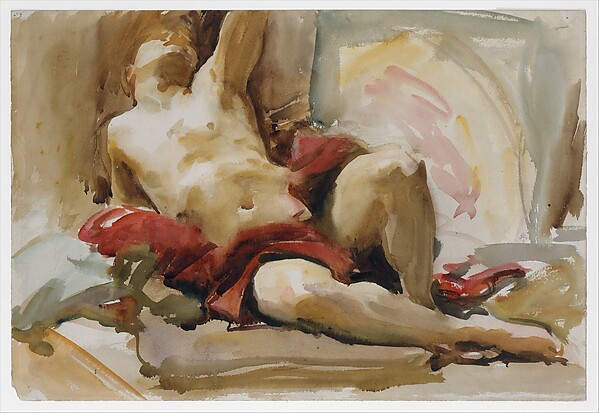
Watercolor and graphite on white wove paper. The Met points out how Sargent shaped parts of the figure with very few marks, leaving bare paper and letting the paint pool. When the white of the paper is part of the painting, its color and surface matter as much as the pigment.
Where to start
- For finished paintings, 300 gsm (140 lb) 100% cotton cold press, as a block or a taped sheet.
- For practice, a wood pulp pad, so you are not worried about wasting paper.
- Try rough if you paint landscapes and water, and hot press if you paint line and detail.
Arches, Saunders Waterford and Fabriano Artistico all make 100% cotton papers. Baohong is a less expensive cotton option.
What I use
For paintings I want to finish, I use Baohong or Arches, both 100% cotton. For practice and trying out ideas, I use a student-grade wood pulp sketchbook, so I don't think twice about wasting a page.
I change the texture depending on what I am painting. Almost everything I do is on 300 gsm, in blocks or sketchbooks, so I rarely have to tape or stretch paper.
I do recommend real watercolor paper, but painting in a cheap sketchbook, or on paper that was never meant for watercolor, has its own kind of fun.
Common questions
Is cold press or hot press better for beginners?
Cold press. It handles both washes and detail and is more forgiving than hot press, where paint dries fast and edges show.
What weight of watercolor paper should I buy?
300 gsm (140 lb) for most work. Lighter paper buckles when wet. 640 gsm (300 lb) stays flat without stretching.
Is 100% cotton watercolor paper worth it?
For finished work, yes. Cotton stays wet longer, so washes blend evenly and color lifts more easily. Wood pulp paper is fine for practice.
Why does my watercolor paper buckle?
It is too light for the amount of water, or it is not taped down. Use 300 gsm or heavier, tape the edges, or paint on a block.
What is the difference between rough and cold press paper?
Rough has a stronger texture. Dry brush strokes skip over it and leave flecks of white, which suits water and foliage. Cold press is in between rough and hot press.